
H Aziz
Tim Souza
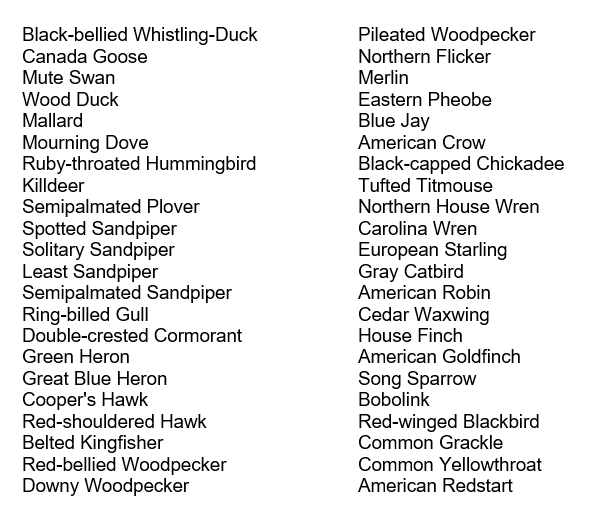
Eight Allen Bird Club members showed up for the Saturday morning walk. We had humid temps in the low 70's and overcast skies. We decided to start our trip in the direction towards the Boy Scout Boardwalk in hopes of getting looks at the Black-bellied Whistling-Duck. As we started out, we spotted a Merlin and a Red-shouldered Hawk, a good start to the walk. Thanks to April for spotting the Black-bellied Whistling-Duck and Bambi with her scope to allow everyone great views from the boardwalk. The remainder of the walk was relatively quiet with a total of 44 species, not much warbler activity. As we ended the trip, I informed the group that I had observed the resident Bald Eagles flying over to West Road carrying nesting material. We decided to go over there to see if we could find the nest site, and with a little bit of luck we did! Let's hope they build this nest a lot stronger than the previous nest. The nest is in the middle of the corn fields and will be visible when the leaves fall.
Click below to view complete list of species.
Dan Burt
On a sunny early September morning eight inquisitive birders entered the trails of the Fannie Stebbins Refuge in search of what birds would present themselves. The weather was cool to start, trails were dry up to the boardwalk, and the temperature warmed as the morning progressed. Along the way to the boardwalk typical denizens appeared including vireos, warbling and red eyed, woodpeckers and of course many Wood Ducks. Three warbler species Common Yellowthroat, American Redstart and Black-and-white were espied by all. In total there were 36 species seen and/or heard. The highlight for most was the view of the Black-bellied Whistling-Duck which was located on the eastern side of the tracks on the northern side marshes just beyond the boardwalk.
As always, the walk was a success, and enjoyment was had by all.

Michele Keane-Moore
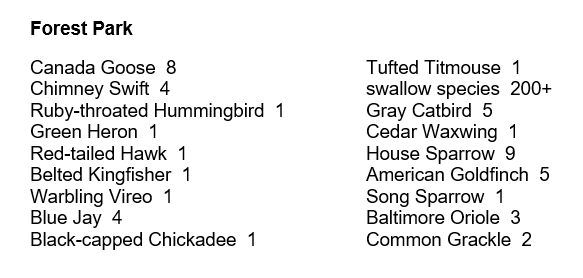
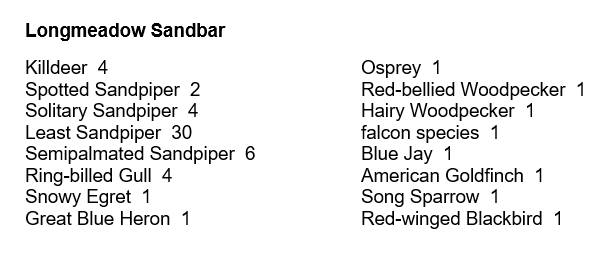
Eleven members gathered to enjoy a morning in search of birds. The meeting area and first birding spot was Pynchon Point Park in Agawam. Next, we visited Forest Park. For the last stop, we headed over to view the Longmeadow Sandbar.
Click below to view complete trip lists for each location.

Al and Lois Richardson
There is good news and bad news to report. The good news is that 21 Allen Bird Club members gathered to watch, share summer birding stories, and munch on cookies. The bad news is there were no sightings of nighthawks. Actually, perhaps because of the wind, there were not the number of species usually seen. There were however the sightings of blackbirds beginning to move together in large flocks, several mallards and wood ducks coming in for the night, the family of mute swans, nine cormorants perched in snags, three Great Blue Herons, a kingfisher, and perhaps the bird getting the most attention was the final bird of the evening - a Great Egret that gracefully flew in and landed at the water’s edge.


Janice Zepko
A dozen birders joined together to bird Plum Island. The weather was full sun with temps in the high 70s and the winds were light, better on the beaches, but calm from inland spots.
The tide was too high at Joppa Flats, so we headed directly to Plum Island for our first birding stop at the Salt Pannes. As we passed the gate we were given the first spectacle of the day, thousands of Tree Swallows swirling in the cluster that nearly filled the sky. At the pannes, we were able to pick out several Barn Swallows joining the Tree Swallows in aerial pursuits. Greater and Lesser Yellowlegs were feeding together, which gave us all a great comparison study in size and Long and Short-billed Dowitchers forced us to look at shape and feeding style in order to get correct identifications. There were Semipalmated and Least Sandpipers and we picked out several White-rumped Sandpipers and a juvenile Stilt Sandpiper mixed in the group. Also there were Great Blue Heron, Northern Harrier, and an Osprey enroute to the end of the refuge.
Unfortunately, Lot 7 was full, as was the parking lot for Emerson Rocks and Sandy Point. Our seven-car brigade meant that we would be hard pressed to find spots in the smaller lots, so we headed to Hellcat, where parking was available. From the dike, we spotted more Greater and Lesser Yellowlegs, another Stilt Sandpiper (this one was an adult), and a Short-billed Dowitcher. Also there were more yellowlegs, a Northern Harrier, Double-crested Cormorant, Gadwall, and Cedar Waxwings.
The Bill Forward Pool blind gave us much of the same and the Pines Trail added Purple Martin and American Goldfinch to the list. A few members ended their birding early and the rest of us grouped together a bit tighter to reduce the numbers of cars and tried once more to get to the birding spots at the south end of the refuge.
Emerson Rocks gave us two Common Terns, a Common Eider, Great Black-backed Gull. Lot 7 was still full, but we did find space to park at Lot 6 and it turned out to be a very good stop. We found Laughing Gull sitting on the water, Bonaparte’s Gull in flight, Sanderlings and Piping Plovers, along with Semipalmated Plovers and Semi-palmated Sandpipers.
Next was a visit to Stage Island Pool. It was very warm by then with no breeze and the mosquitoes were very bad. Though a couple of us made it up the hill to the viewing platform, it was a quick trip with no new birds for our efforts.
One more stop at the Salt Pannes on the way out did not give us any new species for the day-list but did provide a bonanza of Semipalmated Sandpipers and Semipalmated Plovers to scan with hopes of finding something new.
We ended the day with 50 species. Click below to view species list.


Allen Bird Club
P.O. Box 1084
Springfield, MA 01101
Email: info@allenbirdclub.org


