
H Aziz
Janice Zepko
This was our 35th year of participation in Audubon’s Christmas Count as Cobble Mtn Circle, with our first count taking place in 1991. Here’s a rundown of how we did this year compared to past years. We brought in a total of 65 species, up 4 species from last year, and 2 species above average over all the years. Observer effort was up by two birders and hours in the field was the same as last year; both were above average for the count.
Conditions for the count were fairly comfortable, though a 4” snowfall on the previous day made walking on unplowed surfaces more difficult. Waters were mostly frozen on ponds, with very few areas of open water. Moving water was partly frozen with open areas. The temperature ranged from 19-38 degrees F; sunshine prevailed most of the day, with cloud cover creeping in by late afternoon. Winds were 0-7 mph, from the northwest in the morning and from the southwest in the afternoon.
Three species were counted at an all-time high this year, Red-shouldered Hawk at 17 (avg 3), Red-tailed Hawk at 65 (avg 30), and Yellow-bellied Sapsucker at 9 (avg 3).
Found in lower numbers than usual was Black Duck at 11 (avg 53), Ring-billed Gull at just 6 (avg 124), and Golden-crowned Kinglet at 5 (avg 29). The Ring-billed Gull was only counted in lower numbers in 2017, and the Golden-crowned Kinglet was only counted in lower numbers three other times overall.
Unfortunate misses this year were Belted Kingfisher (only missed on 1 other year since 2011) and Red-winged Blackbird (feast or famine for this species).
We were fortunate to find some rarer species. Though Congamond usually gives us a rare species or two, this year the ponds were just about completely frozen over on the surface. The hilltowns won the prize this year. Kathy and Myles found 4 Pine Siskins, identified in only 5 other counts in the last 15 years. Dorrie and Paul spotted 2 Red Crossbills, only recorded on two other counts, and 11 Evening Grosbeaks, not seen since 2007. Vince and Tim found 3 Savannah Sparrows and 2 Chipping Sparrows. Chipping Sparrows have only been counted on two other counts. At lower elevations, Bambi and April spotted a Lincoln’s Sparrow, adding it to the count list as a new species, first time found! They also spotted 2 Ring-necked Ducks in a small opening of South Pond. Janice and Gail heard a Fish Crow and eyed a perched Merlin, which they were able to scope for excellent views. Tim and Joseph spotted the only Purple Finch. This species was recorded in about half of the counts, but less often in recent years. Tom found a lone Northern Pintail, found only sporadically. Bruce, Ilene and Doug found 5 Brown-headed Cowbirds and 3 of the 9 Red-shouldered Hawks. Joanne and Al saw 9 Cedar Waxwings, and Dave and Kim counted 5 in their territory. Dave and Kim also picked up the only Sharp-shinned Hawk and a Yellow-rumped Warbler, only seen in three other counts. Andrea and Jim went owling and found a Great Horned Owl, and together with Qin found a Barred Owl by day and 2 Field Sparrows. Also putting in some owling time, John got 2 Barred Owls, and Janice heard two Barred, one Great Horned, and one Screech. John also found 2 Winter Wrens and the only Hermit Thrush.
Mary Jo helped by counting birds at her feeder in Blandford. Dorrie found 3 count week species, a Snow Goose, a Red-necked Grebe and 4 Common Goldeneye, and Qin spotted a Ring-necked Pheasant.
Special thanks to Joanne Fortin, who hosted the compilation yet again this year. Her generosity allowed us to end our count day with delicious food, lots of laughter, and a camaraderie that cannot be beat!
Click below to view or download complete count results.
Howard Schwartz
Click below to view or download complete count results.
Vince Yurkunas and Janice Zepko
Four members gathered in Ludlow and headed to Cape Ann to enjoy a day of coastal birding. The winds were very light, and it was sunny all morning. Though skies turned overcast in the afternoon, the temperature stayed between 35-40 degrees all day. The birding was comfortable, and the seas were calm.
Our initial stop was the Jodrey State Fish Pier (1) located in the inner harbor of Gloucester, where we picked up our first sightings of Common Eider, Surf Scoter, Red-breasted Merganser, Common Loon, Great Cormorant, and Rock Pigeon. We also spotted a Peregrine Falcon, and all got good scope views of it, perched at the base of a steeple in town. A Common Raven called while we were there, and it turned out to be the only one all day long.
By 9:00 a.m. we were already birding at our second stop, Rocky Neck (2). Here we added Long-tailed Duck, Common Goldeneye, and Bufflehead to the list along with several songbirds. Next spot was Niles Beach (3), where we picked up Black Scoter in addition to those ducks already mentioned. The numbers of Surf Scoters here were in excess of 200.
We spent an hour at Eastern Point (4), first checking the waters near the parking lot and then marching out to the dog bar and the furthest point on the rocks to get sweeping ocean views to the south. Stepping out of the car, we immediately got views of Gadwall and Black Duck, two new species and a third, Horned Larks flying over and calling. At the point, we spotted two Purple Sandpipers resting on the dog bar and 2 Black Guillemots.
Feeling good about our day, we headed to Niles Pond (5). It was mostly frozen over, but we scanned the gulls on the ice, looking in vain for a smaller one, or a whiter one. The water that was open gave us Hooded Merganser, Gadwall, Mallard and Black Duck.
Now on to the Elks Club (6), where we spotted two Red-necked Grebes, 20 White-winged Scoters and a Northern Gannet to add to the growing species list. We stopped at the grocery store in town and added a Great Blue Heron while eating lunch in the parking lot, overlooking the marsh. Granite Pier (7) was next and added Harlequin Duck to our list, along with a singing Carolina Wren.
On to Andrew’s Point (8), where parking in the “new” small lot often gives us songbirds as we make our way through the neighborhood to get to the oceanfront. Indeed, we picked up Northern Mockingbird, Black-capped Chickadee and White-breasted Nuthatch. At the two overlooks on the point, we spotted a group of a dozen Sanderlings and one Dunlin on the rocks and then flying from one location to another. More Gannets were here and over a hundred Black Scoters floated so close to shore, you could hear their murmuring calls of communication. Also present were a hundred Harlequin Ducks, 200 Common Eider, 30 Long-tailed Ducks, a smattering of White-winged Scoters and 4 Common Loons. It was a good spot, and excitement was high in our little group of observers.
Having read a report of a rarer goose at Mill Pond (9) in Gloucester, we headed there next and did spot the Greater White-fronted Goose almost immediately, grazing in the grassy field with many Canada Geese.
From there we headed north to Spencer-Peirce-Little Farm (10) in Newbury to try for another rare bird, the Scissor-tailed Flycatcher. It was not found near the pig pen, where it had been reported, but undaunted, we walked the muddy path flanked by open field on one side and untidy, natural hedge row on the other until it was spotted. Of course it was on the other side of the hedge row, but we all managed several good looks through holes in the vegetation. What a striking bird! He had the salmon-pink flanks and underbelly contrasting with the black wings and tail. We saw the long, deeply forked tail that gave this bird its name, too. What a thrill! On our walk out, we met another birder who described the location of a gray-phase Eastern Screech Owl along the entrance road, and sure enough we found it in its hole high up one trunk of the tree.
There was a bit of light left in the day, and we were close to Salisbury State Park (11), so we voted to try for the Long-eared Owl. The cones were in place in Parking Lot 3 and another birder told us that the owl had been seen this year, but infrequently. We studied the patch of trees where we saw it in February, but luck was not with us this time around.
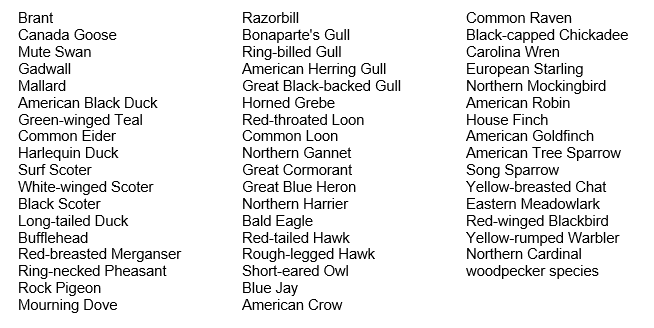
All in all, it was a great day to be out birding. We ended the day with 49 species and 12 new species to add to the club’s 250-challenge for the year. Click below to view species list.


Vince Yurkunas and Janice Zepko
The day was sunny, but blustery with steady winds of 10-15 mph, making the 35-40 degrees temperatures feel much colder. The six members who gathered to bird the coast of Plymouth were not discouraged or disappointed. Two members added seven species to their life lists – who can complain about that!
Stop one was White Horse Beach. There we got our first looks at Common Loon, all three scoter species, with Black and Surf Scoters outnumbering the hand full of White-winged Scoters. Long-tailed Ducks were numerous too, and we counted a half-dozen Horned Grebes. The Northern Gannets were readily visible with binoculars, but spotting scopes brought them in for flawless views.
Next stop was Bartlett Pond, where we added Gadwall, Bufflehead, Black Duck, Mallard and Mute Swan. Several songbirds were spotted here, including Carolina Wren, Tree and Song Sparrows, House Finch, Northern Cardinal, Black-capped Chickadee, Blue Jay and Yellow-rumped Warbler (our only warbler species of the day).
From there, we headed to Manomet Point, the famous seawatch spot, and were lucky to get good looks at a single floating Razorbill. Gannets were also there and not too far out. We added Common Eider, Harlequin Duck in good numbers, and Great Cormorant to the list, as well as a lone Bald Eagle, very high in the sky, spotted by Tim.
Now we were cold enough to take a good break at Leyden Street Coffee. Great beverages and a clean rest room, both were especially welcome.
Plymouth Beach was next, giving us good views of Long-tailed Duck, Horned Grebe and White-winged and Surf Scoters, but no new birds to add to the list. Then Stephen’s Field, which added our first views of Bonaparte’s Gull.
From there we headed to the Plymouth Jetty, where we were greeted by hundreds of Rock Pigeons enjoying the pavement of the large parking lot behind the East Bay Grille. From here, we searched in vain for a different gull among hundreds gracing the rocky beach. Then turning to look in the opposite direction, Bonaparte’s Gulls were spotted again, making their way around the boats close by in the harbor. Their buoyant flight pattern, small size and white on the leading edge of their wings made keeping them in view easy once they were identified.
Jenny’s Pond had a near full parking lot and is a full-blown construction site, but we managed to find Mallard, Black Duck, Gadwall, Mute Swan and added Great Blue Heron and Green-winged Teal.
Our last stop was Cumberland Farms in Halifax, River St. entrance. We arrived early, hoping to find the Say’s Phoebe that had been reported off and on, and as recent as that very morning. We did not see it, but we did spot Tree Sparrow on the dirt road in, a Ring-necked Pheasant running along the road ahead of us, and Rough-legged Hawk being pestered by a Harrier. There were Northern Harriers in abundance. We estimated a minimum of eight, including one “gray ghost.” While waiting for dusk to approach and hoping for looks at Short-eared Owl, we spotted an Eastern Meadowlark fly by with the setting sun lighting up the bright yellow underbody. There were also a dozen Mourning Doves perching on a nearby fence and we heard a Raven call out several times. At last, we spotted the Short-eared Owl and most of us got scope views of one flying low, back and forth over the fields. Three others were counted to round out a great birding day.
We ended up a bit cold, but with smiles on our faces, heading home with a total species count of 52 for the day. We were proud to add 21 new species to our club’s 250-challenge for species spotted on field trips during the club year. Our challenge is a way of celebrating the United States Semiquincentennial, the 250th anniversary of the Declaration of Independence on July 4, 2026.
Click below to view complete species list.

Myles and Kathy Conway
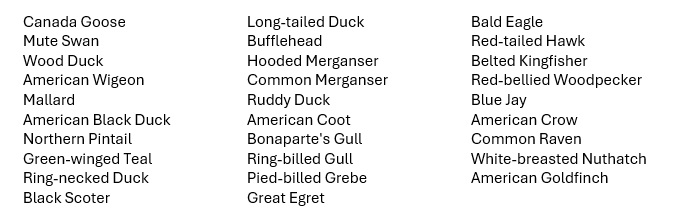
Our annual Berkshire Lakes trip took place on November 1 with 10 members participating. As can be expected in early November, it was cold and windy, but mostly sunny. We tallied 29 species, mostly waterfowl. Land birds were probably quiet due to the wind, but one notable highlight was a kettle of Ravens harassing a Bald Eagle at the so-called "Teal Hole" of the Cheshire Reservoir. Four other Ravens were seen in addition to the kettle. Bald Eagles were another highlight. We counted 7, including 5 from the fishing pier at Burbank Park.
Waterfowl highlights included a Pintail and 4 Coot at Bull Hill on Pontoosuc, along with a late Great Egret. Two Bufflehead were seen later on Pontoosuc; 6 Black Scoter on Onota; and 2 Long-tailed Ducks, 5 Ruddy Ducks and a Pied-billed Grebe on Richmond Pond.
At Bull Hill Myles spied a smaller gull with bright red legs close up. By the time all of us could get on it, it took off with the many other Ring-billed Gulls. We debated and studied our guidebooks and resources, vacillating between Bonaparte's and Black-headed Gulls. The latter would be unusual inland, but Bonaparte's could be expected. When the gulls landed again close by, the smaller gull was in the water and we could not see the legs. The bill, and size, seemed to indi-cate Bonaparte's. We concluded that we had two Bonaparte's Gulls and that is what is on the trip list, despite the "gut feeling" of some of us that the first gull was Black-headed. After the trip, Joseph forwarded a report of a Black-headed Gull seen the same day at Quabbin Reservoir, obviously not close to our Berkshire lakes, but, hmmmm.... Could we have also seen a Black-headed Gull? The conclusion is that when in the field, you should expect the unexpected. When you have the opportunity, take time to study the birds in front of you, taking note of all field marks and behaviors. Because, you never know...
Click below to view species list.


Allen Bird Club
P.O. Box 1084
Springfield, MA 01101
Email: info@allenbirdclub.org


