
H Aziz
April Downey
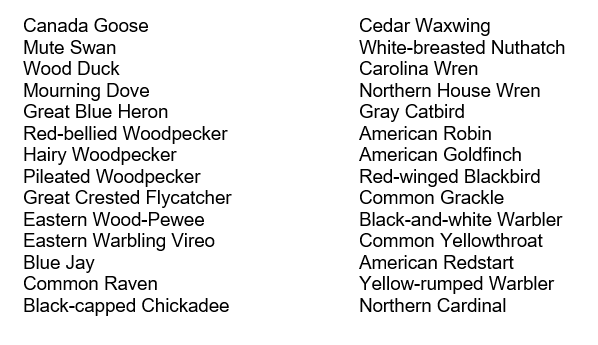
Four members joined for the morning walk and together we counted a total of 28 species. The walk was lacking in migrating warblers until the end, and even then, the light was bad and the birds were located high in the trees. However, that mixed flock of warblers was definitely the highlight of the walk.
Click below to view trip list.
Tim Souza
Ten members joined for our 2.5-hour morning walk, and together we logged a total of 37 species.
While warbler activity was low, we did spot a few vireos (Warbling and Red-eyed) and Blue-Gray Gnatcatchers. We encountered a few pockets of warblers, but they remained high in the treetops and were moving too quickly for positive identification.
Highlights included numerous Wood Ducks in various plumages and quite a few Green Herons. At the sandbar, we observed our usual resident species, as well as Greater Yellowlegs, Least Sandpipers, and a juvenile Bald Eagle.
It was a great way to start the Saturday.

Andrea Bugbee
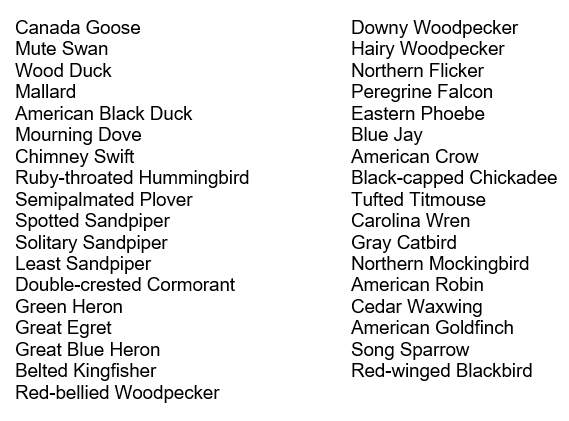
On September 2, the Allen Bird Club began its fall series of Wednesday morning walks, a weekly field trip that invites participants to observe the small changes which herald not only the progression of seasons, but also the ever-changing movements of fall migration. A team of five members facilitated this walk, with two more joining the group toward the end.
The trip's weather ranged from 67 to 72 degrees on a calm, cloudy day immediately following a day of steady rainfall. Mosquitoes were vengeful. Cornell's BirdCast estimated some 45,000 birds migrated over Hampden County on the previous evening, yet the refuge remained fairly quiet.
Still, signs of fall abounded. Katydids changed the preserve's "dawn chorus" to a melody matching the second day of meteorological fall. Wood Ducks, apparent in multitudes, wore a gambit of plumage ranging from female to spotty juvenile to molting male. Multiple Green Herons seemed to pose for close looks and, while raptors were scarce, one club member spotted a Peregrine Falcon perched along the Connecticut River as participants identified sandpipers, plovers, and egrets on the sandbar.
Click below to view complete species list.
Michele and Chris Moore
Twelve members gathered in hopes of witnessing a spectacular flight of Common Nighthawks in Longmeadow. Unfortunately, this unpredictable phenomenon was not to be. One nighthawk was spotted late in the outing, and those who persevered were rewarded with a view.
Participants did enjoy another impressive avian spectacle: a thousand blackbirds flying in large flocks, merging and separating before settling in the trees around the ponds.
Many Wood Ducks were observed, along with a half-dozen Double-crested Cormorants and the usual Mallards, Mute Swans, and Canada Geese. Two Great Blue Herons, a few Chimney Swifts, and a handful of songbirds rounded out the evening. The final species total was 15. Click below to view the complete species list.

Janice Zepko
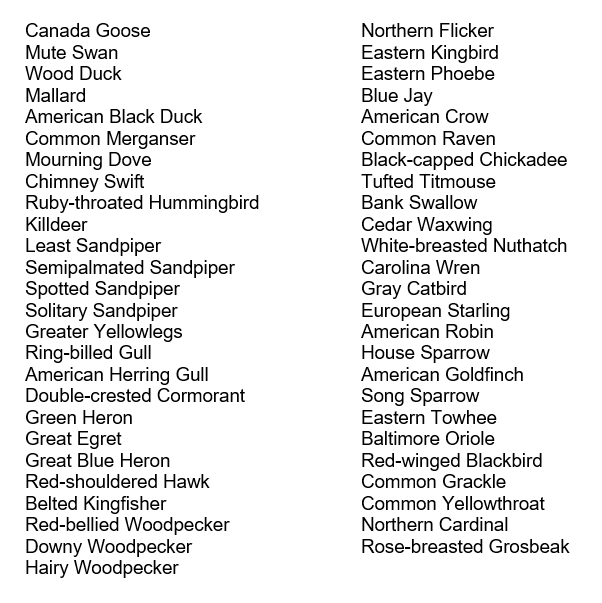
Nine members gathered at Pynchon Point in Agawam to explore the trails, scan the river and shoreline, search the sandbar in Longmeadow, and bird from the viewing platform at Pondside.
At Pynchon Point, one early-arriving member caught sight of a Great Egret and others heard Ravens. Together we identified Carolina Wren, Baltimore Oriole, Chimney Swift, Great Blue Heron, Double-crested Cormorant, Common Merganser, Spotted Sandpiper, and more.
From there, we headed to the Bondi’s Island boat ramp, hoping to find the Red-necked Phalarope reported there the previous day. We had no luck with the phalarope, but we did find two Semipalmated Sandpipers and four Least Sandpipers.
Our next stop was the Longmeadow Sandbar, which is often especially productive near the end of summer, when low water levels expose the sandbar. It provides an important resting and refueling stop for shorebirds continuing their migration along the Connecticut River. We enjoyed nice views of Solitary and Spotted Sandpipers, Killdeer, and a distant Greater Yellowlegs.
The highlight was a huge flock of Bank Swallows, which took turns dancing low over the sandbar and resting in large groups on the exposed beach. We also identified a Red-shouldered Hawk by ear—or perhaps it was a Blue Jay offering a remarkably convincing imitation—as well as Great Blue Heron, American Black Duck, Hairy, Downy, and Red-bellied Woodpeckers, and several other species.
Although the official trip ended at the sandbar, some members continued to Pondside, where they added numerous Wood Ducks, a Mute Swan, a flyover Green Heron, and an Eastern Kingbird to the list. Another member extended the outing by exploring the refuge trails and found Cedar Waxwing, Rose-breasted Grosbeak, Common Yellowthroat, Ruby-throated Hummingbird, and Northern Flicker.
In all, we counted 51 species and enjoyed the cooler morning air, one another’s company, and the opportunity to play at being expert birders. Click below to view complete species list.


Allen Bird Club
P.O. Box 1084
Springfield, MA 01101
Email: info@allenbirdclub.org


